AI-Native Software Engineering

At my current org, I work on the internal developer platform, and we use frontier AI models a lot - for building the platform and for helping other teams adopt AI in their own work. I wanted to see how other companies use AI for software engineering, so we could adopt their best practices. So I started reading - engineering blogs, research papers, conference talks, earnings calls. This post is what I've pieced together so far. I'll keep updating it as things change.
The Productivity Paradox
The first thing I looked into was the basic question: does AI actually make developers faster? The answer is not what I expected.
The study that changed how I think about this came from METR (Model Evaluation and Threat Research). Their mid-2025 randomized controlled trial with experienced open-source developers found developers were actually slower with AI tools - while believing they were about 20% faster. The gap between what they felt and what happened was roughly 39 percentage points. [10] People are bad at judging whether AI is helping them.
Then METR ran a second, larger trial (57 developers, 800+ tasks) with the late-2025 agentic tools - Claude Code and Codex - and published it in February 2026. The slowdown essentially disappeared: newly recruited developers measured about -4%, statistically indistinguishable from zero, and METR itself cautions that selection effects likely bias even that number downward. [60] Two lessons survive both studies. First, measure - don't trust how fast people feel. Second, whatever you measured six months ago is stale: re-run your measurements with current tools before making decisions on old data.
Other studies point the same direction, with caveats. GitHub's study with Accenture found tasks completed 55% faster - but on a controlled, single-task JavaScript exercise, not on messy production work. [37] Anthropic's internal survey of 132 engineers showed a 50% median productivity boost. [7] And Jellyfish, which sells engineering analytics and can see PR data across many companies, reported in 2026 that 64% of teams see at least 25% productivity gains, and that the heaviest AI adopters merge about 1.8x more PRs than the lightest. [73]
How do you make sense of these contradictions? It comes down to what kind of task you're doing. If the task is well-defined and self-contained - writing boilerplate, wiring up an API, building a CRUD endpoint - AI genuinely helps, sometimes by 25-81%. But if you're working in a large codebase you already know well, the AI's generic suggestions often slow you down more than they help. And here's the bigger picture: Bain & Company found that real-world savings are usually just 10-15%, because developers only spend 20-40% of their time actually writing code. The rest is reading, reviewing, debugging, and communicating.
So even in the best case, the speed gains are smaller than they feel. But speed is only half the story. The other half is what happens to code quality when AI is writing more of it.
CodeRabbit's December 2025 analysis of 470 pull requests found AI-generated code has 1.7x more issues per PR, 1.57x more security vulnerabilities, and 2.74x more XSS vulnerabilities than human-written code. [16] GitClear's analysis of 211 million lines of code shows refactoring collapsed from 25% to under 10% of commits, while code duplication grew 4x. [18] Their 2026 follow-up shows the trend deepening, not correcting: refactoring fell further to 3.8% of changed lines in early 2026, and duplicated blocks are up 81% compared to 2023 - the highest on record. [64] Cortex's 2026 benchmark report shows change failure rates (the share of deploys that cause a failure in production) up 30% and incidents per PR up 23.5%. AI is producing more code, faster, with more bugs.
The DORA amplifier effect
Google's DORA (DevOps Research and Assessment) group runs the industry's largest annual study of engineering performance. Their 2025 report found that AI magnifies whatever already exists in an organization. [12] Teams with strong engineering foundations see AI as a force multiplier. Teams with broken processes see AI make things worse - delivery stability drops 7.2% and throughput falls 1.5%. Only 9% of companies achieve AI value at scale.
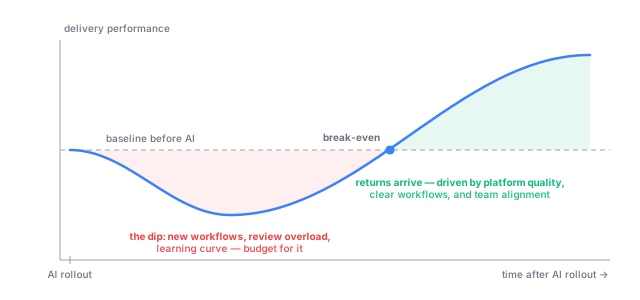
DORA's April 2026 follow-up, the ROI of AI report, adds a second lesson: value follows a J-curve - metrics often get worse before they get better, and the returns come from platform quality, clear workflows, and team alignment, not from the tools themselves. [63] When you roll out AI, budget for the dip.
How to Think About AI-Assisted Development
Martin Fowler - one of the most influential writers on software design - has published extensively on this throughout 2025-2026, and his thinking gives teams a practical framework. His core argument: LLMs are a paradigm shift comparable to the move from assembly language to high-level languages - not just a productivity tool but a change in the nature of programming itself.
His most useful insight, drawing on Rebecca Parsons: all LLM output is hallucination - we just find some of it useful. This reframe has practical consequences. Teams need to borrow the concept of tolerances from structural engineering - determining acceptable error rates for AI-generated work.
LLMs are quite happy to say ‘all tests green,’ yet when I run them, there are failures.
— Martin Fowler
Three principles from Fowler's work:
- Refactoring is more important than ever. AI-generated code duplicates logic rather than abstracting it. Schedule refactoring sprints deliberately.
- Review is the new bottleneck. “There's a lot more code going out there, a lot more code to review.”
- Experiment and share openly. Fowler is characteristically honest: “Anyone who says they know what this future will be is talking from an inappropriate orifice.”
Kent Beck - the creator of test-driven development - adds a complementary view: TDD is a superpower when working with AI agents, because agents actively introduce regressions - and will even delete tests to make them “pass.” [21] His system: write failing tests first, let AI generate code to pass them, then review and refactor. In Stack Overflow's 2025 survey, 72% of professional developers said “vibe coding” (hoping AI output just works) is not part of their work. [23]
ThoughtWorks' Technology Radar - a twice-yearly industry report on which techniques are worth adopting - formalized an important shift in its November 2025 edition: context engineering has replaced prompt engineering as the key skill. [33]
The difference matters. Prompt engineering is about crafting the right question. Context engineering is about curating what the AI can see before it even starts working. In practice, this means:
- CLAUDE.md / AGENTS.md files at the repo, module, and project level - giving agents the project's conventions, architecture decisions, and coding standards
- Tool subsets per task - agents should only see tools relevant to their current task. Too many tools degrades reasoning (more on this in the Stripe section below).
- Just-in-Time (JIT) instructions - Shopify ran into what they call the “tool complexity problem.” At 0-20 tools, things were fine. At 20-50, boundaries blurred. At 50+, the system prompt became an unwieldy mess of special cases and conflicting guidance - what they called “death by a thousand instructions.” Their fix: instead of cramming all guidance into the system prompt upfront, they return relevant instructions alongside the tool data only when that tool is actually called. The system prompt stays focused on core behavior, and modifying one tool's instructions doesn't invalidate the cache for the entire prompt. After implementing JIT, maintenance costs dropped, response speed improved, and task completion accuracy went up.
- Repository vector indexes - GitHub Workspace indexes your entire codebase so the agent understands how changes relate to the broader project
- “Onboard like a new hire” documentation - OpenAI's Harness team found that if an architectural decision lives only in a Slack thread, it's invisible to the agent
The common thread: the quality of AI output depends more on what you put into the context window than on how clever your prompt is.
The April 2026 Radar (Volume 34) doubled down on context engineering and added three themes worth acting on. [65] First, cognitive debt: AI-accelerated complexity demands a return to engineering fundamentals, because code nobody understands accumulates faster than code nobody wrote. Second, putting coding agents on a leash: constrain what agents can do, not just what they see - capped retries, scoped file access, mandatory checkpoints. Third, securing permission-hungry agents: agents ask for broad permissions by default, so grant the minimum access a task needs, and connect only the tool servers (MCP servers - more on MCP later) that the task actually uses. If your agents currently run with your full credentials, this is the first thing to fix.
What the Best Companies Are Actually Doing
2025-26
 GitHub Copilot
20M users
4.7M paid subscribers, 75% YoY growth.
Deployed at 90% of Fortune 100 companies.
Auto-reviewed 8M+ pull requests by Apr 2025.
 Amazon
$260M/yr saved
Q Developer migrated 30,000 Java apps internally.
79% of auto-generated code shipped unchanged.
Largest enterprise AI migration to date.
2025
Apr 2026
 Google
~75% AI-generated
Rose from 25% (Q3 2024) to ~75% by April 2026.
All AI code reviewed and accepted by humans.
Autorater evaluation loops woven into pipelines.
 DoorDash
90%+ daily usage
AI tools used by engineers every working day.
Integrated across frontend, backend, and mobile.
Q1 2026
Q1 2026
 Airbnb
80%+ engineers
Majority of engineering org uses AI tools daily.
Focus on search, listings, and payments teams.
 Stripe
1,300+ AI PRs/week
Minions: production-grade autonomous agents.
Blueprint architecture: deterministic + agentic nodes.
70% of AI PRs merge without modification.
Hard cap: max 2 CI rounds per agent task.
Feb 2026
2026
 Meta
Meta~50% agent-assisted
About half of code changes now agent-assisted.
Target: 65% of engineers writing 75%+ of code with AI.
DevMate platform plus an internal 'GitHub for agents'.
 HubSpot
97% AI-assisted
Nearly every commit involves AI tooling.
Highest reported AI adoption rate in industry.
Q1 2026
Q1 2026
 Grab
Grab98%+ engineers
Virtually all engineers use AI coding tools daily.
Southeast Asia's largest tech company by AI adoption.
Anthropic: the most aggressive AI-native culture
70-80% of Anthropic's technical employees use Claude Code every day, and the tool itself was 90% written by Claude Code. [7] Their survey of 132 engineers (conducted August 2025, published December 2025) found AI used in 59% of work (up from 28% a year earlier), with a 67% increase in merged PRs per engineer. The most interesting finding: 27% of Claude-assisted work consists of tasks that wouldn't have been done otherwise - papercut fixes and quality improvements teams couldn't justify before.
By mid-2026 the numbers had moved again. In “When AI Builds Itself” (June 2026), Anthropic disclosed that Claude now writes more than 80% of the code merged to production at the company, measured through an attribution pipeline, and that engineers ship roughly 8x as much code per quarter as a few years ago. [61] One pattern from that report is directly copyable: they run Claude Code as scheduled daily automated maintenance on their own systems - dependency bumps, lint debt, small fixes - and about 46% of its automated PRs merge. A recurring agent job with a tracked merge rate is something any team can set up this week.
Their workflow: Explore, Plan, Code, Commit. They start by preventing Claude from writing code, having it research and plan first. Engineers run 2-4 simultaneous Claude instances using git worktrees (parallel checkouts of the same repo, so agents don't overwrite each other's changes). They describe themselves as “managers of AI agents” - spending 70%+ of time reviewing, not writing.[46]
But Anthropic's survey also surfaced real concerns. Engineers worry about skills atrophy - the “paradox of supervision” where effective AI oversight requires coding skills that may decay from AI overuse. Social dynamics are shifting: “I work way more with Claude than with any of my colleagues.” Mentorship is disrupted: “More junior people don't come to me with questions as often.”
One notable experiment: Nicholas Carlini used 16 Claude Opus 4.6 agents in parallel Docker containers to build a 100,000-line Rust-based C compiler. It passed ~99% of GCC's torture tests (the brutal edge-case suite used to validate the standard C compiler) and compiled QEMU, FFmpeg, SQLite, Postgres, Redis, and Lua. The total API cost was $20,000 in tokens - a fraction of what a team of engineers would cost to build the same thing over months. [8]
Stripe: 1,300 AI-written PRs per week
Stripe's Minions system is one of the better-documented production-grade agent deployments. [1] [2] The core architectural innovation: Blueprints - sequences where some nodes run deterministic code (file I/O, linting, tests, git) and others run an LLM for judgment. The design principle: “The system runs the model, not the other way round.”
Agents run on “devboxes” - isolated EC2 instances that were originally built for human developers. Agents walked in and benefited automatically. Their internal tool server (“Toolshed”) exposes nearly 500 tools - code search, docs, tickets, build status - but each agent gets a curated subset per task. Handing an agent all 500 at once would drown its context window and degrade its reasoning.
The feedback loop is aggressive and capped. Local lint runs on every push in under 5 seconds. CI runs selective tests from a 3M+ test battery, with autofixes applied automatically for known failure patterns. If failures remain, the agent gets one more chance. Hard cap: maximum 2 CI rounds. If code doesn't pass after the second push, it goes back to the human. A typical on-call scenario: engineer fires off 5 Slack tasks before getting coffee, returns to find 5 PRs ready, approves 3, sends feedback on 1, discards 1. About 70% of AI-written PRs merge without modification.
OpenAI: the Harness experiment
OpenAI's Harness project built an entire product where every line of code was written by Codex agents. Humans steered; agents executed. Starting from an empty repo in late August 2025, a team of three (growing to seven) shipped roughly 1 million lines - application code, tests, CI, docs, tooling - over about five months, at an estimated 1/10th the time of hand-written development. [3] Codex itself passed 2 million weekly active users in March 2026.
Their key insight: “Context is everything, not prompting.” If an architectural decision lives only in a Slack thread, it's invisible to the agent - just like it would be to a new hire joining three months later.
They favor “boring tech” - stable APIs and widely used libraries. Agents work better with them because the model has seen them thousands of times in its training data. The key workflow: engineers run 3-4 completely independent tasks simultaneously. They describe the problem in short sentences, fire off the task, immediately switch to the next one, and return later to check status.
Meta: adoption as a management target
Meta's approach is worth studying because it treats AI adoption like any other engineering metric: measured, targeted, and reported. Internal goals set in early 2026 called for 65% of engineers in the central product org to write more than 75% of their code with AI assistance in the first half of 2026, and roughly half of code changes there are now agent-assisted. [72] Their internal platform (DevMate) sits alongside what employees describe as a “GitHub for AI agents” at the source-control layer, and in August 2026 they shipped Muse Code, a terminal coding agent aimed at large codebases. [77] The transferable lesson is less about the tooling and more about the management style: if adoption matters to you, set explicit targets and measure them.
Other companies
Shopify built a centralized LLM proxy rather than standardizing on a single tool - allowing experimentation while keeping centralized cost control. [14] Their key lesson: “Standardize infrastructure, not tools.” Senior engineers now routinely run multiple agents in parallel.
GitHub's Copilot Coding Agent works asynchronously - you assign an issue and come back to find a ready PR. [27]
Their March 2026 agentic code review creates a closed loop: review finds problem, Coding Agent generates fix, engineer reviews the result. In July 2026 it gained agent skills and MCP support, so reviews can now invoke your team's internal tools and standards. Microsoft's internal system AI-reviews 90%+ of their 600K+ monthly PRs. [28] And a July 2026 study of Microsoft's own rollout of CLI coding agents (Claude Code and Copilot CLI) measured adopters merging 24% more PRs per engineer per day, sustained over four months - some of the strongest causal evidence yet that terminal agents are worth piloting. [69]
Google's defining lesson for 2025: “Agents got jobs, evaluation became architecture, and trust became the bottleneck.” [13] Unpacked: agents now do real production work, checking their output is built into the systems themselves, and the limiting factor is whether humans trust the results.
Their autorater system - an LLM acting as judge - evaluates each agent output in real-time. When it detects an error, it provides feedback the agent uses to retry and correct itself, without human intervention for routine issues. High-stakes situations escalate to human approval. This is a fundamental shift: evaluation is not something you do after the fact - it's an active component in the execution pipeline. The share of AI-generated code keeps climbing: at Cloud Next in April 2026, Sundar Pichai put it at ~75% of new code at Google, up from ~50% just months earlier - with every AI-generated line still human-reviewed. [62]
Google also sees role blurring accelerating: “Five years ago, companies had very clear roles - backend engineers, frontend engineers, architects, designers, quality engineers. This siloed approach is evolving. Today's tools enable engineers to operate across domains that previously required specialized expertise.”
Six Principles of AI-Native Engineering
Across all these companies, the same patterns keep showing up. No one coordinated these - they emerged independently from teams solving the same problems at scale.
Cross-firm principles - what every top engineering team agrees on
The system runs the model
Agents fail when given unlimited autonomy. Every successful deployment constrains the LLM inside a fixed orchestration shell: blueprints (Stripe), AGENTS.md (OpenAI/GitHub), plan mode (Anthropic), autorater loops (Google). The walls matter more than the model.
Stripe, Anthropic, GitHub, Google
Good human infra = good agent infra
Stripe didn't build agent-specific infrastructure. The devboxes, linters, and CI were built for humans. Agents walked in and benefited automatically. Investment in developer experience is also investment in agent capability - not separate work streams.
Stripe, Anthropic (git worktrees), OpenAI
Context engineering, not prompt engineering
Every firm has converged on curating what the agent sees rather than how you ask it. Toolshed tool subsets (Stripe), AGENTS.md / CLAUDE.md hierarchy (Anthropic/OpenAI), Just-in-Time instructions (Shopify), repo vector index (GitHub).
All firms, Dropbox, Manus
Human gate is load-bearing
No firm has removed human review. Stripe: "The mandatory reviewer is doing more work than the model." GitHub: author retains control. Anthropic: humans own taste decisions. OpenAI: tiered review. The gate is not a bottleneck to optimise away - it's architecture.
All firms - universally
Parallelism beats iteration
The gain comes from running 3-10 agents simultaneously, not from making one agent smarter. Stripe fires 5 Slack tasks before coffee. Shopify runs 10 parallel agents. OpenAI uses best-of-N selection. Anthropic runs 2-4 git worktrees. Batch dispatch, not interactive refinement.
Stripe, Shopify, Anthropic, OpenAI
Evaluation is architecture (not measurement)
Google's defining 2025 lesson: evaluation woven into the pipeline as an active component. LLM-as-judge autoraters don't just measure - they provide feedback that agents act on in the same loop. Eval adoption is at 52% and rising.
Google, Anthropic, LangChain survey
Anti-patterns these firms actively avoid
Giving agents unlimited tool access
Shopify hit the "tool complexity problem" at 50+ tools. Stripe curates a per-task subset. GitHub cut from 40+ to 13 core tools using embedding-guided selection. Flooding context degrades quality and inflates cost.
Uncapped retry loops
Stripe's hard limit: 2 CI rounds. OpenAI: test feedback is bounded. "LLMs show diminishing returns retrying the same problem." Unlimited loops compound errors, inflate costs, and mask the real failure signal.
Agent infra separated from developer infra
If agents run in different environments from humans - different CI, linters, test suites - you build a two-track system that diverges over time. Stripe's insight: one environment for both.
Measuring code volume without outcomes
Port.io found 63 earnings calls with AI code metrics but zero tied to deployment frequency or MTTR. Google DORA: AI is an amplifier, not an outcome. Track the four DORA metrics, not just PRs/week.
The anti-patterns are equally consistent: unlimited tool access, uncapped retry loops, and measuring code volume without tying it to actual engineering outcomes.
The SWE-bench Leaderboard: What It Really Measures
SWE-bench Verified is the most-watched benchmark for coding agents. It tests whether an AI can take a real GitHub issue and produce a working pull request. Top scores jumped from about 65% in early 2025 to ~81% by March 2026 [43] - and then the benchmark effectively saturated: by August 2026 the leaders sit at 95-97%, with Claude Opus 5 at 96%. [66] When every frontier model clears 95%, the benchmark stops telling you which one to pick.
These scores look impressive, but they don't tell the full story. SWE-bench Pro is a harder version of the same test, designed so models can't cheat by having seen the answers during training. Pro is moving fast too - from ~23% in early 2026 to 59% on Scale's standardized leaderboard by August (GPT-5.4), with vendor-reported runs claiming up to 80%. [67] The narrowing gap between Verified and Pro suggests genuine improvement rather than memorization. Still, the caveats stand: METR found that about half the PRs that pass the tests would get rejected by actual maintainers - they pass technically but aren't good enough to merge. Devin AI merges 67% of its PRs in production, but when independently tested on complex tasks, that dropped to just 15%. [30]
The AI coding tool market
The three biggest tools tell the story. GitHub Copilot has the widest reach: 20 million users (as of mid-2025), 4.7 million paid subscribers (January 2026), and deployments at 90% of Fortune 100 companies. [57] Cursor grew from $1M ARR in 2023 to roughly $3B by mid-2026 - and in June 2026, SpaceX agreed to acquire its maker Anysphere for $60 billion, the largest acquisition of a venture-backed startup ever. [70]
But developers' preference has shifted to Claude Code. The Pragmatic Engineer's 2026 survey of 906 developers found it became the most-used AI coding tool just 8 months after launch - 46% named it their favorite, versus 19% for Cursor and 9% for Copilot. [22] Its revenue grew from about $500M to $8B annualized in eight months. And the field keeps widening: Google's Antigravity 2.0, xAI's Grok Build, and Meta's Muse Code all launched in 2026. The practical takeaway: don't bet your workflow on one vendor - the leaderboard has flipped twice in eighteen months.
How This Changes Agile, DevOps, and Architecture
Sprint planning needs a new step
During sprint planning, teams now need to decide which tasks are good for AI and which need a human. Architecture decisions, security-sensitive code, and anything requiring deep domain knowledge should stay human. Boilerplate, test scaffolding, migrations, and well-defined implementation tasks can go to AI.
The context engineering practices described earlier - CLAUDE.md files, detailed specs, curated tool access - make the biggest difference here. The spec becomes the contract the agent works against. [9]
Your Definition of Done needs updating
AI-generated code needs a stricter checklist than human code. Based on what teams are reporting:
- Same PR review process as human code - no shortcuts
- AI-generated sections tagged so you know what came from where
- Mandatory security review for anything touching login, access control, or data storage
- At least 70% test coverage, with humans writing the test descriptions
- Check what packages AI added - one team found 23 new npm packages after a month of heavy AI use, 7 of them unmaintained and 2 with known vulnerabilities
Without these guardrails, teams report 35-40% more bugs within six months. [39]
TDD matters more now, not less
This is the one thing everyone agrees on - Fowler, Beck, DORA elite performers, the Codemanship research group. [32] Studies show AI produces measurably better code when you give it tests alongside the problem description. [38] If your tests break after an AI change, go back to the last working commit. Leaving broken code in the context window makes all future AI output worse.
Code review is now the slowest step
AI generates code faster than teams can review it. PRs are about 18% larger with AI, and incidents are up ~24%. As Addy Osmani put it: “AI did not kill code review. It made the burden of proof explicit.” [31]
What works in practice:
- Let AI do the first pass - style checks, basic security, static analysis
- Human reviewers focus on the hard stuff: architecture, intent, edge cases, security boundaries
- Extra attention on anything touching auth, payments, or user data
- Every PR needs proof it works - tests, verification logs, screenshots
- Break AI output into small commits, not one giant PR
The rule: the human always has final say.
Standups and retros need new questions
Add one question to your daily standup: “What AI tools did you use and what did you learn?” This turns individual discoveries into team knowledge. For distributed teams, AI-summarized async standups can pull out blockers and group related work, saving managers 1-2 hours a week. [23]
For retros, let AI analyze your sprint metrics - defect trends, cycle time, ticket churn - and surface patterns you might miss. But be aware of the isolation problem: in Stack Overflow's 2025 survey, only 17% of AI agent users said agents improved team collaboration - even though ~70% agreed they cut task time. The main benefit is still personal productivity. Make sure people keep pairing and talking to each other, not just to their AI tools.
Make your codebase agent-friendly
Consistent naming, strong typing, and well-scoped modules make a huge difference for AI agents. Code that humans navigate through tribal knowledge (“oh, that function name is misleading but everyone here knows what it does”) is a dead end for agents. Treat agent-friendliness as an architecture concern, just like performance and security.
AI is creating tech debt faster than humans ever did
The GitClear data from earlier tells the story: refactoring down, duplication up - and an independent study of agent-assisted repositories measured cognitive complexity up 39%. [75] The reason is simple - agents optimize for making tests pass, not for clean architecture. The fix: schedule dedicated refactoring sprints, and give AI refactoring tasks too, not just feature work.
CI/CD is getting smarter
Build pipelines are evolving from fixed step-by-step sequences to flows that adapt based on what changed:
AI quality gates. Add AI-specific rules to your existing static analysis tools (SonarQube, Snyk, ESLint). AI code tends to have patterns human code doesn't - excessive I/O operations (8x the human rate per CodeRabbit), duplicated logic instead of abstractions, and overly permissive error handling. Create custom rules that flag these. Run them as a required CI step that blocks merge if they fail.
Smart test selection. Instead of running your entire test suite on every push, analyze which files changed and only run the tests that cover those files. Tools like Bazel, Jest's --changedSince, and Stripe's selective test runner do this. The payoff is huge - Stripe has 3M+ tests but only runs a relevant subset per push. This turns a 30-minute CI run into a 3-minute one.
Self-healing pipelines. Set up monitors that watch your deployment metrics (error rates, latency, CPU). When something spikes after a deploy, the pipeline automatically rolls back to the last known good version, pages the on-call, and creates a ticket with the context. No human needs to wake up at 3am to click “rollback.” Kubernetes with Argo Rollouts or Flagger can do progressive delivery with automatic rollback built in.
Flaky test detection. Track which tests sometimes pass and sometimes fail on the same code. ML models can learn to identify these by looking at test history, execution time variance, and dependency patterns. Quarantine flaky tests into a separate non-blocking suite so they stop slowing down your team. Fix them in dedicated cleanup sprints.
Sandboxed environments for agents. AI-generated code should never run directly against production data or services during development. Give each agent its own isolated container with no internet access and no production credentials - similar to how Stripe runs Minions on disposable devboxes and how OpenAI Codex disables internet during execution. If the agent writes something destructive, the blast radius is zero.
Separate AI vs. human dashboards. Tag commits and PRs by whether they were AI-generated or human-written. Then track error rates, change failure rates, review time, and incidents separately for each. This tells you whether AI is actually helping or just producing more code that breaks more often. Without this split, you can't tell if your rising incident count is from AI adoption or something else entirely.
Monthly AI code audits. Once a month, randomly pick 10 files that were primarily AI-generated. Have a senior engineer do a deep review - not for correctness (CI should catch that) but for architectural quality, unnecessary complexity, hidden tech debt, security patterns, and whether the code is actually maintainable by a human. Document what you find and feed it back into your CLAUDE.md context files so the AI makes fewer of the same mistakes.
About 40% of platform teams have adopted some form of AIOps (AI-assisted IT operations), cutting unplanned downtime by ~20% (Gartner).
Self-healing software is starting to work
The idea: AI agents watch your pipelines, detect when something breaks, figure out the cause, and fix it - or roll back to the last working version - all without a human touching it. Be realistic about the numbers here: published evaluations report MTTR reductions in the 50-80% range (one study measured ~25 minutes down to ~8), while the “seconds-level” recovery claims you see in vendor material are marketing. Self-healing systems today handle only a minority of real-world failure classes - keep humans in the escalation path.
The multi-agent landscape
A few frameworks have emerged as the main options: LangGraph for production-grade work (40M+ monthly downloads; in production at Uber, LinkedIn, and Klarna), CrewAI for quick prototyping (12M+ daily agent executions), and Microsoft Agent Framework for Azure environments, with OpenAI's Agents SDK and Google's ADK rounding out the field. Gartner saw a 1,445% increase in multi-agent inquiries between early 2024 and early 2025, and predicts 40% of enterprise apps will have embedded AI agents by end of 2026.
Two protocols matter: Anthropic's MCP (Model Context Protocol) for connecting AI to tools, and A2A (Agent-to-Agent) for agents talking to each other - originated at Google, now governed by the Linux Foundation with 150+ member organizations. [71] ThoughtWorks put MCP in their Trial ring but warned against blindly converting every API to an MCP endpoint - and their 2026 guidance adds: load only the MCP servers a task needs, because every connected server eats context. [33]
What Comes Next: 2026-2027
AI coding agents are getting better fast. The standard way to measure this is METR's “time horizon”: the longest task (measured in human working hours) that a model completes successfully at least half the time. That horizon has been doubling every 3-4 months on the recent trend (6.3 months averaged over all time). [68] Claude Opus 4.5 (November 2025) could handle ~5-hour tasks. By end of 2026, models are expected to manage 20-hour tasks - almost half a work week. The AI 2027 project - a widely discussed AI capability forecast led by a former OpenAI researcher - originally predicted a “superhuman coder” by March 2027; as of mid-2026 its own tracker puts reality at about 70% of the predicted pace, and the authors have pushed the milestone out to late 2027 - mid 2028. [76]
Claude Opus 4.6 still holds the published record for the longest task an AI can do reliably: 14 hours 30 minutes (measured by METR) - though METR notes the measurement is extremely noisy because its task suite is nearly saturated, and none of the mid-2026 models have been measured yet. [49] The model landscape itself turned over since spring: GPT-5.5 (April), Anthropic's Claude Fable 5 and Mythos 5 (June) and Claude Opus 5 (July), and the open-weight DeepSeek V4 Pro now all sit at or near the frontier.
Context windows - how much information the model can see at once - have made 1 million tokens the de facto standard across frontier models, with advertised windows ranging from 256K (GPT-5.5) to 10 million (Gemini 3 Pro - though nothing yet shows quality holding at that length). Entire codebases fit in context. The real progress now is in reasoning quality and the ability to work autonomously for longer periods.
One trend worth watching: Stanford data shows jobs for developers aged 22-25 dropped nearly 20% from peak, while jobs for those 35-49 went up 9% - and Stanford's AI Index 2026 confirms the trend has not reversed. [42] [74] AI makes experience more valuable while making entry-level positions harder to justify. Some teams are adopting “Copilot-free Fridays” - one day per week with no AI tools - specifically to keep their skills sharp.
The Bottom Line
After going through all of this, here's where I've landed:
AI changes how engineering works, not whether you need engineers. The companies getting real value (just 6% according to McKinsey) are 3x more likely to have redesigned their workflows. Just plugging in AI tools without changing your process doesn't help. [24]
More code is not the same as better software. Port.io looked at 63 earnings calls where companies proudly announced their AI code metrics. None of them connected those numbers to things that actually matter - how often they deploy, how fast they recover from incidents, how long it takes to ship a feature. [35]
The hard part has shifted. Writing code used to be the bottleneck. Now it's reviewing it, testing it, and making sure it all works together. Teams that don't adjust to this new reality will ship more code and more bugs at the same time.
The tools have changed. The principles haven't. Experiment rigorously, measure honestly, share openly, and maintain the engineering discipline that made your team effective in the first place.
If you're wondering where to start, here's a phased plan based on what worked for the teams I studied. Not everything applies to every team - pick what fits your situation and skip the rest. The order matters though: get the basics right before scaling.
Start here
The first things you can do are small and low-risk. Update your Definition of Done to call out AI-generated code explicitly. Add “What AI tools did you use and what did you learn?” to your standups so the team shares what's working. Create CLAUDE.md or AGENTS.md files for your main repos - this is the single highest-leverage thing you can do for AI code quality. Make a rule that AI never writes both the code and the tests for that code. Grant agents least-privilege access from day one - load only the MCP servers and tools a task needs, never your full credentials. And add at least one AI-specific quality gate to your CI pipeline.
Once you have the basics
Adopt the TDD-first workflow described above and restructure code review into AI-first-pass, human-second-pass. Start tracking AI vs. human code metrics separately - error rates, cycle time, review outcomes. Without this data, you're flying blind. Run a controlled experiment on one team to actually measure whether AI is helping before you roll it out everywhere - and re-run it quarterly, because METR's follow-up showed the answer changed within six months as the tools improved. Expect a J-curve: DORA's ROI data says metrics often dip before they improve, so agree upfront how long you'll wait before judging. And set up a shared prompt and workflow library so people aren't reinventing the wheel.
As your team matures
Think about how your team is spending its time. If engineers are still writing most code by hand, you may need to shift toward more reviewing and less typing. Invest in making your codebase agent-friendly (see the earlier section). Set up self-healing patterns for your most critical pipelines. Give agents recurring maintenance chores - dependency bumps, lint debt, papercut fixes - as a scheduled job with a tracked merge rate, the way Anthropic runs daily automated maintenance at a ~46% merge rate. Pilot CLI agents if you haven't: Microsoft's internal rollout measured 24% more merged PRs per engineer. Start a monthly AI code audit - pick 10 random AI-generated files and have a senior engineer review them deeply. Plan for MCP integration in your architecture. And schedule explicit refactoring sprints, because AI-generated debt accumulates faster than you think.
Looking further ahead
Before scaling AI adoption further, assess where you actually stand against DORA's 7-capability model - fix foundational weaknesses first, because AI will amplify whatever is broken. For new projects, design AI-native from the start: built-in observability, fallback logic when models fail, evaluation systems for output quality. Invest in multi-agent orchestration capabilities. Start planning for the junior developer pipeline problem - if entry-level jobs shrink, you need structured mentorship and AI-free learning paths so the next generation of engineers can still build real skills. And budget for compute costs going up significantly: agents use about 4x more tokens than chat, and multi-agent setups use 15x.
References
Engineering blogs and research papers
- Stripe Engineering Blog. “Minions: Stripe's one-shot, end-to-end coding agents (Part 1).” January 2026. stripe.dev
- Stripe Engineering Blog. “Minions Part 2.” February 2026. stripe.dev
- OpenAI. “Harness engineering: leveraging Codex in an agent-first world.” February 2026. openai.com
- Anthropic. “How AI is transforming work at Anthropic.” December 2025. anthropic.com
- Anthropic Engineering. “Building a C compiler with a team of parallel Claudes.” February 2026. anthropic.com
- Anthropic. “2026 Agentic Coding Trends Report.” anthropic.com
Productivity studies
- METR. “Measuring the Impact of Early-2025 AI on Experienced Open-Source Developer Productivity.” July 2025. metr.org
- Google Cloud. “Announcing the 2025 DORA Report.” cloud.google.com
- Google Cloud CTO Office. “AI grew up and got a job: lessons from 2025.” December 2025. cloud.google.com
- Bessemer Venture Partners. “Inside Shopify's AI-first engineering playbook.” April 2026. bvp.com
Code quality research
- CodeRabbit. “State of AI vs human code generation report.” December 2025. coderabbit.ai
- GitClear. “AI Code Quality Research 2025.” jonas.rs
Methodology and frameworks
- The Pragmatic Engineer. “TDD, AI agents and coding with Kent Beck.” 2025. pragmaticengineer.com
- The Pragmatic Engineer. “AI Tooling for Software Engineers in 2026.” pragmaticengineer.com
- Stack Overflow. “2025 Developer Survey - AI section.” stackoverflow.co
- McKinsey. “The state of AI in 2025.” mckinsey.com
- McKinsey. “Measuring AI in software development.” mckinsey.com
GitHub, Microsoft, and tools
- GitHub Universe 2025. “AgentHQ and Copilot Coding Agent announcements.” infoq.com
- Microsoft Developer Blogs. “Enhancing Code Quality at Scale with AI-Powered Code Reviews.” devblogs.microsoft.com
- Cognition AI. “Devin's 2025 Performance Review.” cognition.ai
- Addy Osmani. “Code Review in the Age of AI.” January 2026. addyo.substack.com
- Codemanship. “Why Does TDD Work So Well in AI-assisted Programming?” January 2026. codemanship.wordpress.com
- ThoughtWorks. “Technology Radar Volume 33.” November 2025. thoughtworks.com
Industry analysis
- Port.io. “63 earnings calls. 0 engineering outcomes tied to AI.” port.io
- Dohmke et al. “The Impact of AI on Developer Productivity: Evidence from GitHub Copilot.” 2023. arXiv
- “Test-Driven Development for Code Generation.” 2024. arXiv
- ByteIota. “AI Coding Quality Crisis: 1.7x More Bugs, Trust Crashes 29%.” byteiota.com
- Morgan Stanley. “AI in Software Development: Creating Jobs and Redefining Roles.” morganstanley.com
- SWE-Bench Verified Leaderboard, March 2026. marc0.dev
Company practices and tools
- Coder.com. “How AI Agents Are Redefining Developer Workflows at Anthropic.” coder.com
- philippdubach.com. “Claude Opus 4.6: Benchmarks, 1M Context & Coding Guide.” philippdubach.com
- AI 2027 project. AI capability trajectory forecasting. ai-2027.com
- Fortune. “Over 25% of Google's code is written by AI, Sundar Pichai says.” fortune.com
- Quantumrun. “GitHub Copilot Statistics 2026.” quantumrun.com
August 2026 update
- METR. “Update on our developer uplift study.” February 2026. metr.org
- Anthropic. “When AI Builds Itself.” June 2026. anthropic.com
- Fast Company. “Google CEO says 75% of the company's code is AI-generated.” April 2026. fastcompany.com
- DORA. “The ROI of AI-assisted Software Development.” April 2026. dora.dev
- GitClear. “The Maintainability Gap: 2026 AI Code Quality Research.” gitclear.com
- ThoughtWorks. “Technology Radar Volume 34.” April 2026. thoughtworks.com
- BenchLM. SWE-bench Verified leaderboard, August 2026. benchlm.ai
- Scale AI. SWE-bench Pro public leaderboard. labs.scale.com
- METR. “Time Horizon 1.1.” January 2026. metr.org
- “Adoption and Impact of Command-Line AI Coding Agents: A Study of Microsoft's Early 2026 Rollout of Claude Code and GitHub Copilot CLI.” July 2026. arXiv
- Quartz. “SpaceX is buying Cursor-maker Anysphere in a $60 billion deal.” June 2026. qz.com
- Linux Foundation. “A2A protocol surpasses 150 organizations.” April 2026. linuxfoundation.org
- People Matters. “Meta sets AI coding targets.” March 2026. peoplematters.in
- Jellyfish. “2026 State of Engineering Management.” May 2026. jellyfish.co
- Stanford HAI. “AI Index Report 2026” (economy chapter). hai.stanford.edu
- “To What Extent Does Agent-generated Code Require Maintenance?” 2026. arXiv
- AI 2027 Tracker. Superhuman coder prediction status. ai2027-tracker.com
- TechCrunch. “Meta launches Muse Code, an AI agent for large code bases.” August 2026. techcrunch.com